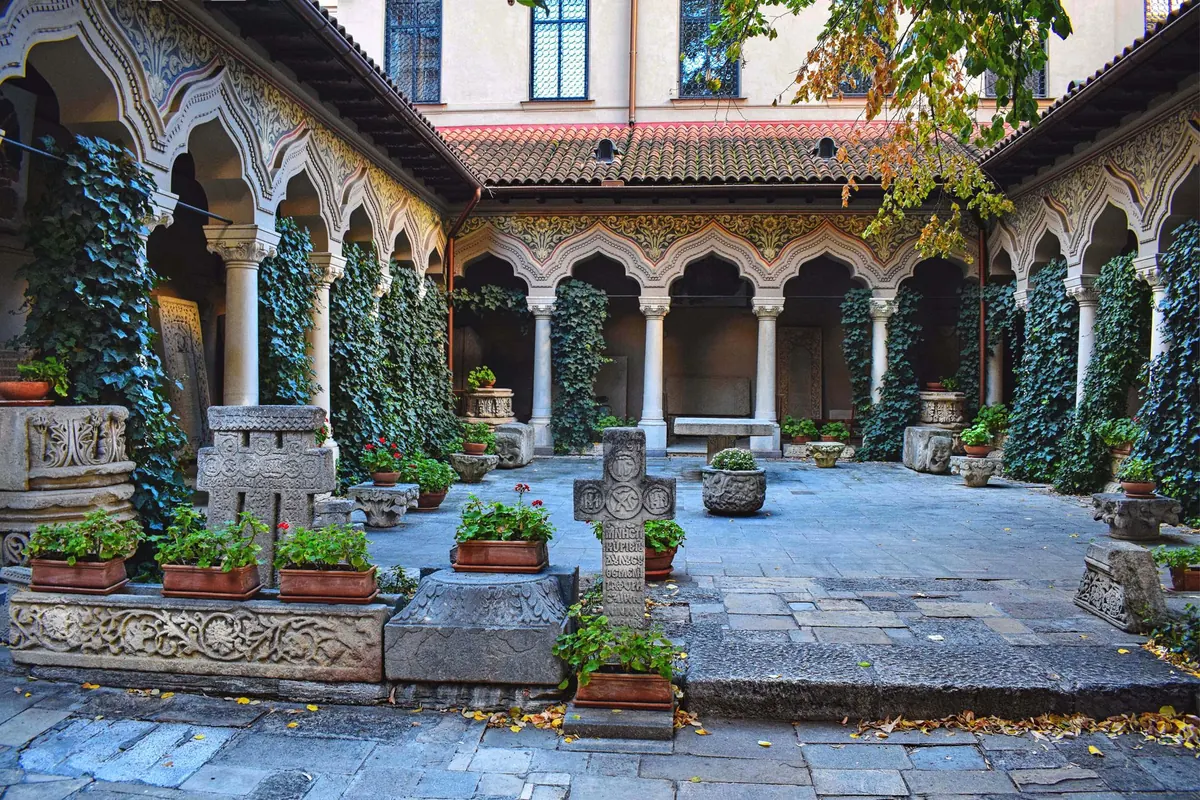
Walk through the gate of a working Orthodox monastery in Romania, Serbia, Bulgaria or Georgia and you are stepping into somebody's daily routine rather than a museum's opening hours. Monks and nuns live, pray, cook and work here; the frescoes on the walls are part of the job, not a backdrop for a photo. That single fact explains almost every rule you will meet inside. Visitors who get it right — a scarf in the bag, a phone on silent, one glance at the posted service times — are usually met with real warmth. Those who don't tend to be remembered mainly by the sound of their camera shutter.
Some monasteries are large, well organised and thoroughly used to foreign visitors: Rila in Bulgaria, the Meteora houses in Greece, Kyiv Pechersk Lavra, Trinity-Sergius near Moscow. Others are small communities where a single nun opens the door, sizes you up kindly and points at a sign. In both cases the routine is the same. Stop at the entrance, look for the noticeboard, and if nothing is written in a language you read, ask. A short "Is it all right to visit the church now?" will save you an awkward half hour.
Expect some doors to be closed to you. Living quarters, workshops, kitchens and hermitages are private, and a gate across a path is not an invitation to duck under it. Also worth knowing before you build an itinerary: Mount Athos in Greece admits men only and requires a permit arranged well in advance, and several monasteries in the region restrict access to certain areas during fasting periods or major feasts. If you arrive while a service is in progress, don't begin touring the church. Stand quietly at the back, or wait in the courtyard until it ends.
Orthodox dress expectations are conservative and easy to satisfy once you know the pattern. The basic rule is shoulders and knees covered for everyone, no bare midriffs, nothing tight or beach-like. Inside the church, men remove hats; women often cover their hair, and in Russia, Serbia, Georgia and much of Romania a headscarf is the norm rather than an option. Greek monasteries are generally a little more relaxed about women's heads, but not about shoulders and legs.
Many monasteries in Romania, Bulgaria and Greece keep a rail of borrowed skirts and aprons by the gate, and nobody will think less of you for using them. Still, arriving prepared is more comfortable than wrapping yourself in communal fabric at the door.
You are welcome to watch, listen and stand. You are not expected to cross yourself, bow or follow every gesture — visitors who copy the crowd badly draw more attention than those who simply stand still with their hands at their sides. Keep your voice low, switch your phone to silent, and avoid walking across the centre of the church while people are praying, particularly in front of the iconostasis, the screen of icons at the east end.
Icons are greeted with a small bow and a kiss, usually on the hand or feet of the figure rather than the face; a kiss to the air just above the image is perfectly acceptable and less awkward than it sounds. If a cloth is provided, use it. The altar and the area behind the iconostasis are for clergy, and women do not enter them. Communion is reserved for Orthodox Christians who have prepared for it — if you are not Orthodox, don't join the line; simply stay where you are and let it pass.
If a priest greets you, a nod and "Father, bless" with open palms is a graceful response, but a smile works equally well. Orthodox Christians greet one another with "Christ is risen" during the weeks after Easter. Outside that season, a normal hello is fine. And if you are wondering about the custom of keeping away from church during menstruation, it is a private devotional matter in some traditions and no one will ask you about it either way.
Exteriors and courtyards are generally fair game; interiors are not, and the signs at the door usually say so. Flash is the bigger issue even where photography is allowed, because repeated bright light degrades pigments. Those painted walls you came to see are often centuries old.
The monastic day is built around prayer, and the timetable you find at the gate is the one that matters — printed guides and old blog posts go out of date. The shape of the day is fairly consistent, though: Matins and the Divine Liturgy in the early morning, often starting between six and nine, and Vespers in the late afternoon or early evening. Many houses close their gates for a few hours after the midday meal, especially in summer.
Two approaches work well. Arriving half an hour before a service, when the church is empty and the light is coming through the windows, is the calmest way to see the interior. Coming back for the first twenty minutes of Vespers, standing at the back, is the easiest way to hear the chanting without committing to a service that can run for two hours or more. Sunday and feast days are busy with pilgrims; a weekday morning is almost always quieter.
Every monastery keeps its own patronal feast, known as hram in Bulgaria and Serbia and by similar names elsewhere. These are extraordinary days to witness — long processions, crowds from surrounding villages, bells from early morning — but the monastery is not geared to sightseeing then. Expect parts of the complex to be closed, parking to be impossible and patience to be required. If you plan a multi-monastery road trip, two houses in a day is plenty. Four is a blur of identical courtyards.
Most monasteries sell candles, icons, honey, wine and bread from a small shop, and cash in small notes is genuinely useful. Donations go in the box by the candles rather than into anyone's hand. Some larger pilgrimage houses serve simple meals to visitors for a small contribution; ask quietly and don't assume. A few accept overnight guests, but this is normally arranged in advance and comes with house rules about meals, silence and hours.
Simple courtesies go a long way: keep smoking and alcohol outside the walls, dress as you would inside the church even in the courtyard, and learn the word for thank you in the local language. You will hear it back.
None of this is complicated, and none of it requires you to be religious. It requires only the recognition that you are a guest in a place that runs on prayer rather than on visitor numbers — and that the welcome you receive depends, quietly and reliably, on how you behave at the door.